
The Death of Dumb Forms
The Death of Dumb Forms
FEBRUARY 16, 2026
Every question you ask a user is a small withdrawal from their patience account. What if the form already knew most of the answers, and only asked about the gaps?
A user uploads their bank statement — hundreds of transactions, each one a tiny confession about how they live. That data tells us they shop at Whole Foods (not Walmart), take Ubers (not the bus), and have a Netflix subscription (but no gym membership). So why would we then ask "Do you prefer organic groceries?" We wouldn't. That's the entire thesis behind what we built.
The Intelligence Layer
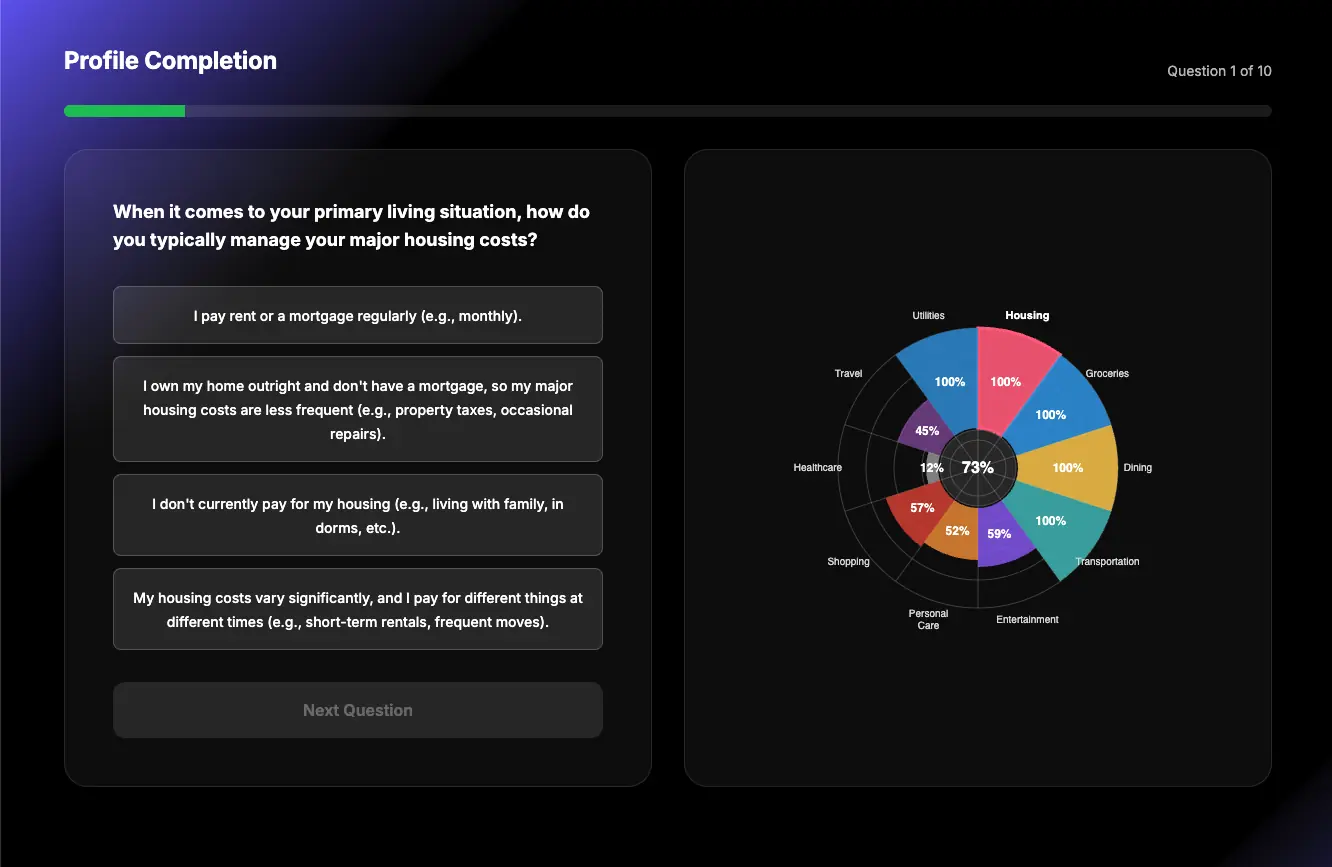
On the surface it looks like a clean ten-question wizard. Behind the scenes, a second system maintains a living map of everything we know and everything we don't — a polar area chart across ten spending dimensions. Each segment fills as our confidence grows. The thin slices are where the questions come from.
We use an LLM to construct each question in real-time given the full context of what we already know. If the system sees 92% completeness in Groceries but 15% in Entertainment, it's not going to ask about food. Every answer updates the profile, the gap analysis shifts, and the next question targets whatever is now the weakest point.
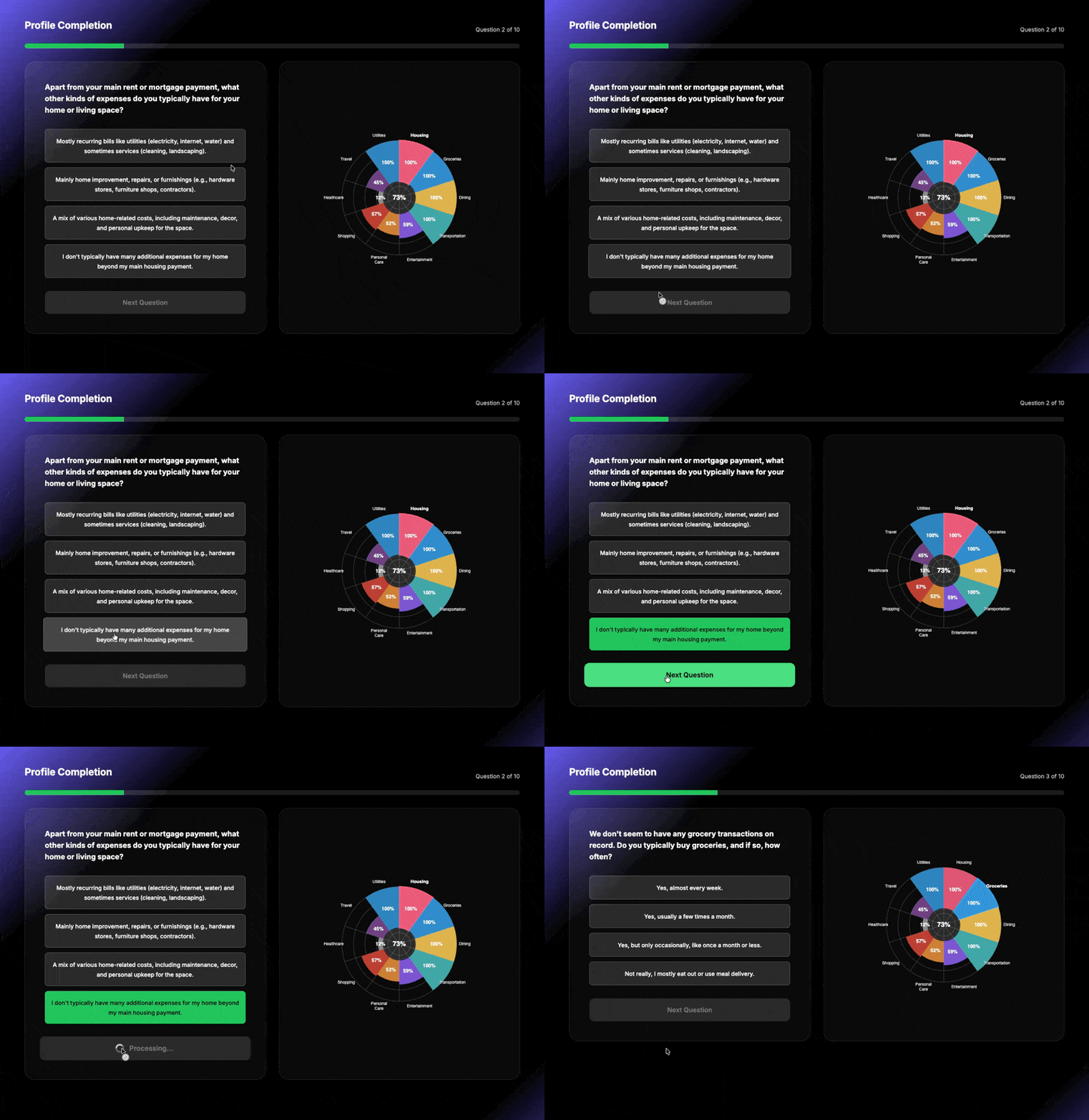
Ten iterations of this loop builds a profile that would traditionally require 30-40 questions — because we're not wasting any on things we already know.
Beyond Forms
The principle isn't really about forms. It's about information-aware interaction design — a system that maintains a model of its own knowledge state and uses that model to decide what to do next. Onboarding flows that adapt based on what OAuth already told you. Medical intake that skips questions answered by insurance data. Support bots that don't ask for your order number when they already have your email.
Know what you know, identify what you don't, and only ask about the delta.
The hard part isn't generating good questions — the AI handles that once you give it the right context. The hard part is building an accurate model of what you already know. Get the gap analysis wrong, and you ask redundant questions. Get it right, and every question feels like it was written specifically for this user. Because it was.

ComfyUI Locally - Early Testing
I've set up ComfyUI to run completely locally on my machine, allowing me to generate AI images without any cloud processing or API costs. Here's a look at my setup and some example generations.

MidJourney + RunwayML Workflow Magic
Explore how I used MidJourney and RunwayML to bring historical and modern cities to life through AI-generated images and animations.

Trust In Dak
Dak Prescott orchestrates one of the greatest comebacks in Cowboys history, rallying from down 21 to beat the Eagles at home.
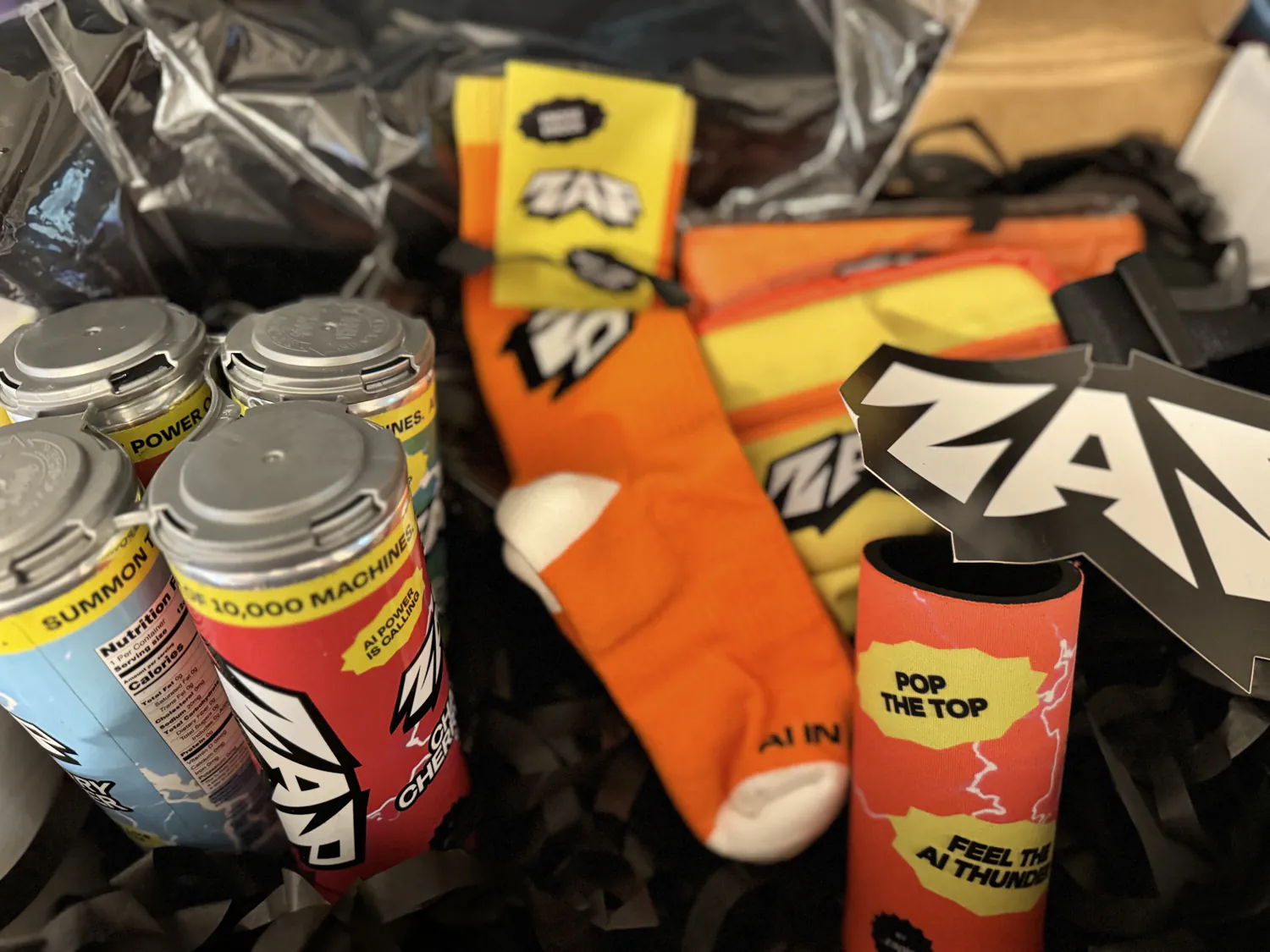
Ummm ... Thank You Zapier?
I received a box filled with branded swag from Zapier today. Such a fun campaign to promote their Zaps! and new AI enhanced capabilities.

El Jefe Toy Pack
The ultimate vanity toy for the real Mayor of Austin. One of these days I'm going to print this out and make this a real thing.